TL;DR: If your clinic runs a 15% no-show and cancellation rate, the US PT industry average you are losing roughly six figures in revenue each year for every full-time clinician on your schedule. The cause is almost never patient apathy. It is the absence of a system that confirms, reminds, and rebooks automatically. This post breaks down the real cost, the three reasons clinics tolerate it, and the four-layer system that brings the rate below 8% without adding staff.
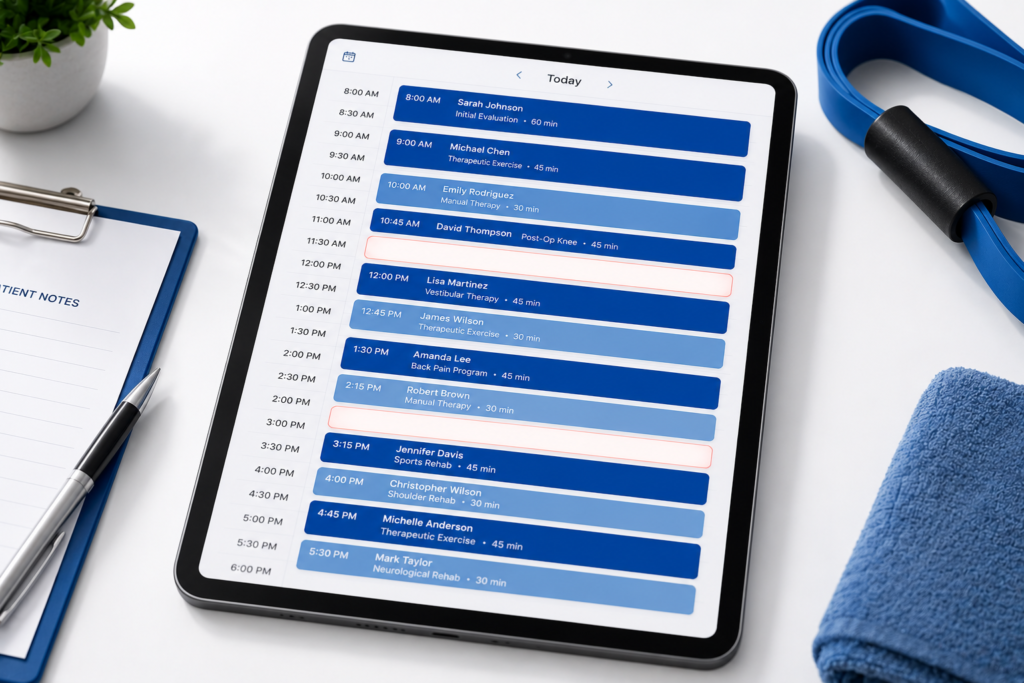
A 15% no-show and cancellation rate is the US average for outpatient physical therapy clinics. That number is so common most owners dont pay attention to it, but hey should start.
For a single full-time clinician seeing 50 visits a week at an average reimbursement of $95 per session, a 15% no-show rate is roughly $37,000 in lost revenue per clinician per year. For a three-therapist clinic, that is over a $110,000 leak before you have spent a dollar on marketing.
Estimate your weekly no-show cost: Weekly Visits × No-Show Rate × Average Reimbursement
What is the average no-show rate for a physical therapy clinic?
Across published US data, the answer falls in a wide band depending on setting and how cancellations are counted. The most cited industry figure is a 15% combined no-show and late-cancel rate. A national survey of 802 outpatient PT clinics published found a mean no-show rate of 10.4%. The largest single US study, covering nearly 445,000 musculoskeletal patients, found 73% missed at least one scheduled appointment over the course of their care.
We don’t need to worry about which number is right. We need to be concerned that even the most conservative figure represents a recurring, predictable revenue loss that compounds week after week.
Why do PT patients no-show?
The reasons are remarkably consistent across studies. the most commonly reported reasons were:
- Forgetting the appointment
- A family or personal emergency
- A scheduling conflict with another appointment perceived as equally important
- Lack of transportation
- Feeling better, or feeling worse, on the day of the visit
None of those reasons are about the quality of your care. They are about friction, memory, and the gap between intent and follow-through. Every single one is solvable with a system. None of them are solved by another conversation about patient commitment at the front desk.
When you apply basic marketing principles and tactics to your clinic the ability to drive down no shows and reengage with those that will inevitably happen upward trajectory is inevitable.
When one of our clients in Illinois implemented text messaging, or SMS, marketing they saw an increase in show rate of 25%. A simple reminder message not only acted as what it was intended for – a reminder, but also offered the lead the opportunity to easily reschedule if something had come up. By including a prompt to confirm with a ‘Y’ and then a link to reschedule if their answer was ‘N” they were able to increase show rate, as well as reschedule rate for leads.
It’s not always about going over the top- simple implementations can make the difference.
What does a no-show actually cost?
Most clinic owners only count the lost session. The real cost is wider.
- Lost revenue from the missed visit (the obvious cost)
- Lost downstream visits when the patient drops out of their plan of care entirely
- Reduced clinical outcomes, patients who miss sessions get worse results, which weakens your reviews and referrals
- Front-desk time burned chasing reschedules instead of converting new leads
- Schedule fragmentation that makes it harder to fill the gap with a waitlist patient
An Indianapolis-based outpatient study quantified the financial damage at $257,724.57 in a single academic year for one clinic. The downstream cost, worse outcomes, lower lifetime value, weaker reviews are harder to measure and bigger.
Why don’t reminder calls fix the problem?
Most PT clinics already do reminders. Phone calls the day before. Maybe a text. The Prompt 2026 Practice Growth Index found that 96% of US practices use automated reminders. And yet the average no-show rate is still 15%.
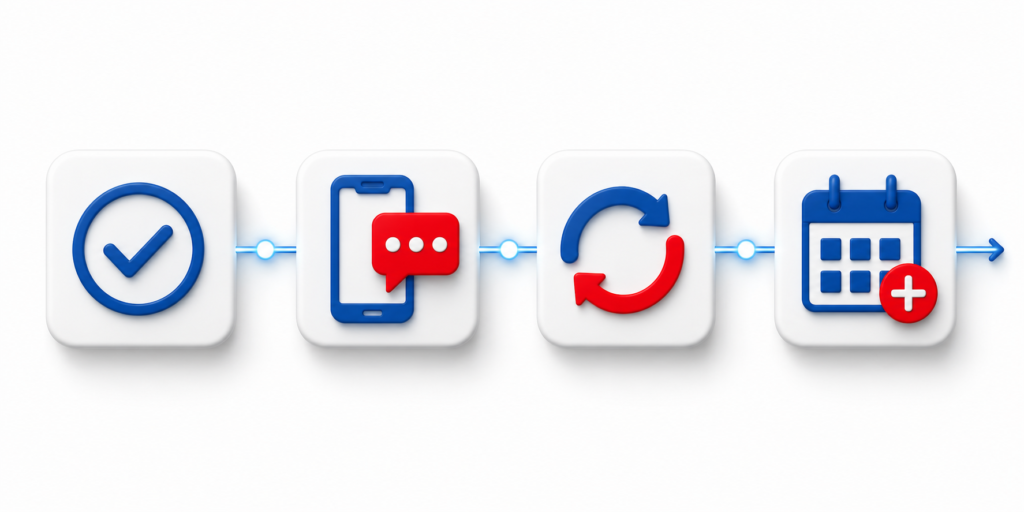
The reason is that a single reminder, sent at one moment, is not a system. It is a notification. A working system has multiple layers, not one:
- Confirmation at the time of booking. The patient actively agrees to the slot, not just receives one
- Layered reminders. Multiple touchpoints across SMS, email, and voice at intervals proven to lift attendance
- Friction-free rescheduling. a link they can tap to move the visit, not a phone tree to navigate
- Automatic backfill. The moment a cancellation lands, the slot is offered to a waitlist patient by text within minutes
How do high-growth PT clinics get their no-show rate below 8%?
550 US rehab clinics found that high-growth practices (>10% annual revenue growth) are 1.4x more likely to automate workflows across intake, scheduling, reminders, and billing. The Medscape April 2026 reporting on patient no-shows highlighted one health system that cut PT late cancellations by 7% in a month after implementing automated 24-hour cancellation policies, opening capacity for more than 1,000 new patients in 30 days.
The pattern in every dataset is the same. Clinics that drop their no-show rate by half do four things consistently:
- They confirm at booking, not just remind before the visit
- They reach the patient on at least two channels (SMS plus email is the floor)
- They make rescheduling a one-tap action, not a phone call
- They have an automated waitlist that fills cancelled slots without staff lifting a finger
In our experience ensuring multiple touchpoints over a well thought out and tested time period gets the best results. We’re all bombarded by communications, and attention grabs. So building a strategy that is customized to your consumer is paramount not only for success but also to hedge overload.
Don’t be afraid to communicate with your audience. Valuable information and communication is never looked down upon, especially when you’re talking to a solid, hot lead.
What about a cancellation policy, does charging a fee work?
Yes, when paired with a system. Without one, it just makes patients angry. The Medscape April 2026 piece cited the late-cancellation fee as the lever that recovered over 1,000 patient slots in a single month, but the fee was the visible part of a policy that included automated 24-hour confirmation requests and easy reschedule links. The fee alone does not fix the problem. The fee plus the system does.
If you cannot enforce a cancellation policy fairly because your front desk is buried, the answer is not to drop the policy. The answer is to automate the enforcement so it happens consistently for every patient, not just the ones a staff member remembered to flag.
The math for cutting your no-show rate in half
Take a three-clinician practice with $1.4M in annual revenue and a 15% no-show rate. Cutting that rate to 7.5% is a realistic outcome with a four-layer system. It recovers roughly $105,000 a year. No new patients are needed, there is no new marketing spend or additional clinical hours. Just the visits already on the schedule actually happening.
That is the cheapest growth lever in physical therapy. It is also the most ignored one, despite the solution being simple.
The math for cutting your no-show rate in half
Take a three-clinician practice with $1.4M in annual revenue and a 15% no-show rate. Cutting that rate to 7.5% is a realistic outcome with a four-layer system. It recovers roughly $105,000 a year. No new patients are needed, there is no new marketing spend or additional clinical hours. Just the visits already on the schedule actually happening.
That is the cheapest growth lever in physical therapy. It is also the most ignored one, despite the solution being simple.
If you want to see exactly how this works inside ClickPhys.io, you can book a walkthrough at clickphys.io and see the no-show system live on the platform.
Where ClickPhys.io fits
ClickPhys.io is built for exactly this. Automated multi-channel reminders across SMS, email, and voice. Confirmation at the time of booking. One-tap reschedule links. Automatic waitlist backfill the moment a cancellation lands. Missed-call text-back so the patient who tries to cancel after-hours still gets a reply and a reschedule option before they go to bed.
ClickPhys.io is built by The Sharpe Agency, which has over 30 years of experience in marketing and growth. If your clinic is running at the 15% industry average, the system is the cheapest fix in your business.
For more on the operations layer of patient retention, see our existing aritcle how clinics turn visits into long-term care.
What PT clinics need to know
What is a good no-show rate for a PT clinic?
Industry data puts the average at 15% combined no-shows and late cancellations. A well-run system targets 5–8%. Below 5% is achievable but usually involves a cash-pay or membership model where the patient has financial skin in the game.
Will a stricter no-show policy lose me patients?
The data says no, when the policy is enforced fairly and paired with easy rescheduling. The Medscape April 2026 reporting documented the opposite. Stricter policies, applied through automation, recovered capacity and let clinics take on more patients.
How long does it take to see a change in no-show rate after switching to automated reminders?
Most clinics see a measurable drop in the first 30 days. The full benefit, including automated waitlist backfill, typically lands by month two as the system has had time to learn your patient patterns.
What is the single biggest factor in reducing no-shows?
Confirmation at the time of booking. Studies and clinic data consistently show that patients who actively confirm their slot attend at significantly higher rates than patients who get a passive reminder the day before.
Stop Losing Revenue to No-Shows
A 15% no-show rate is industry average. It is also an expensive one to leave in place. The cheapest growth lever in your clinic is not more ads or new patients, it is keeping the visits already on your schedule from disappearing. A four-layer system (confirmation, multi-channel reminders, one-tap rescheduling, automatic waitlist) realistically cuts the rate in half within 60 days. For most three-therapist practices, that is more than $100,000 of recovered revenue at almost no marginal cost. The math will not change. The leak just stops.
References
Beaming Health, Physical Therapy Statistics 2025–2026
Bokinskie J. et al., Patient No-show for Outpatient Physical Therapy: A National Survey
Prompt Health, 2026 Practice Growth Index
Medscape, Patient No-Shows: Why Stable Rates Mask a Stubborn Problem (April 2026)
pteverywhere, No-Shows Shouldn’t Derail Your PT Practice
https://pubmed.ncbi.nlm.nih.gov/25497123/
https://www.sciencedirect.com/science/article/abs/pii/S0887899414006511